Published by:

Prateek Ahuja
Like this article?
Key Takeaways
UAE inheritance rules differ by religious status, with Muslims generally subject to Shariah-based succession rules and non-Muslims governed by the applicable civil inheritance framework.
Registered Wills provide greater certainty over estate distribution, with the available options and permitted testamentary flexibility depending on the individual's religious status.
Property owners should align their ownership structures, family circumstances, and registered Will with the applicable UAE inheritance framework as part of comprehensive estate planning.
Introduction:
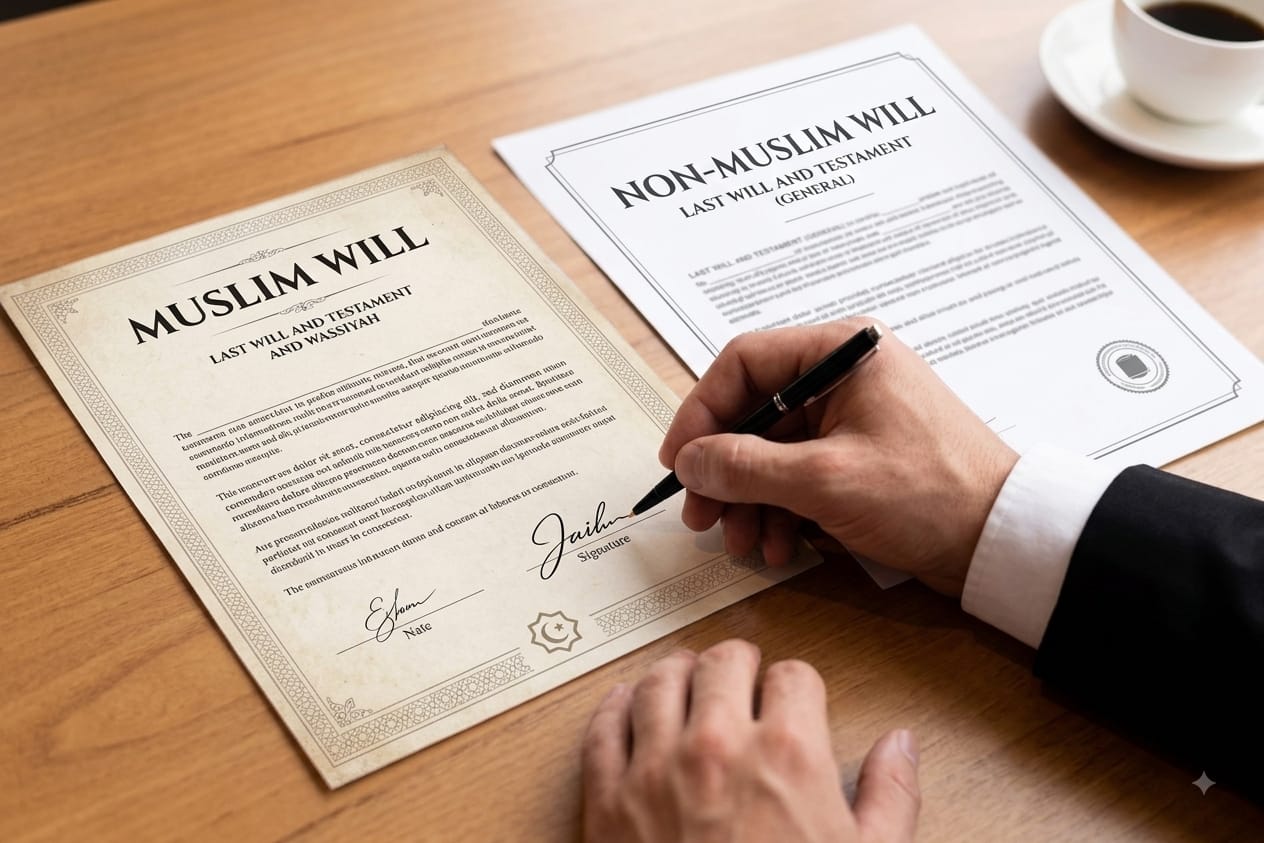
Protecting your estate begins with understanding PRYPCO Will Service and requirements for Muslims and non-Muslim Wills. In the UAE, Muslims and non-Muslims are subject to different inheritance frameworks, which means the type of Will suitable for one individual may not be appropriate for another, even if both own similar property portfolios. This distinction has important legal implications. It determines which court has jurisdiction, how assets are distributed if no Will exists, and the level of control an individual has over the distribution of their estate. For anyone building wealth in the UAE through real estate, savings, or business interests, understanding the legal framework governing their estate is a fundamental part of effective real estate planning.
How the UAE Inheritance Law Is Applied Based on Religion?
The UAE follows two separate inheritance frameworks. Muslim residents and citizens are governed by Shariah-based personal status law under Federal Decree-Law No. 41 of 2024, which replaced the 2005 Personal Status Law. Non-Muslim residents are governed by Federal Decree-Law No. 41 of 2022 on Civil Personal Status, which came into effect on 1 February 2023. Although both frameworks operate within the UAE court system, they can lead to different outcomes when distributing the same estate. The inheritance rules that apply in the UAE depend on a person's religion at the time of death, unless they have a valid registered Will that states otherwise. Muslim citizens and residents generally follow Shariah inheritance rules by default. Non-Muslim citizens and residents are covered by the civil inheritance law introduced in 2022, unless they have legally chosen another applicable law through a registered Will. In some cases, determining the correct legal framework is not straightforward.
Religious conversion, mixed-faith families, or missing documentation can create uncertainty. When this happens, the estate remains frozen until the court confirms which inheritance law applies before the assets can be distributed. For Muslim expatriates residing or owning assets in the UAE, the inheritance framework is inherently guided by Shariah principles codified under UAE Personal Status Law. Unlike non-Muslims who can utilise civil inheritance frameworks or registered DIFC Wills to freely distribute 100% of their assets, a Muslim expat’s estate is subject to statutory rules. While a Muslim individual can register a formal Will (Wasiyah), legal legislation restricts its scope: a Will can only modify the distribution for up to one-third of the total estate, usually directed toward non-heirs or specific bequests. The remaining two-thirds must strictly follow mandatory Shariah inheritance distributions among legal heirs (such as spouses, children, and parents).
How Shariah Wills Work for Muslims in the UAE?
For Muslim residents, an estate is distributed according to fixed inheritance shares under Shariah law. These shares, known as Fara'id, are based on Quranic principles and form part of UAE law. They apply by default and generally cannot be changed based on personal preference, except to the limited extent permitted through a Will. Under a Shariah Will, Muslim residents in the UAE can leave up to one-third of their net estate to non-heirs or charitable causes. The remaining two-thirds must be distributed according to the inheritance shares set out under Shariah law. In most cases, a son receives twice the share of a daughter within the same family relationship. A widow generally receives one-eighth of the estate if the deceased has children and one-quarter if there are no children. If children survive, each parent usually receives one-sixth of the estate, while the remaining assets are distributed among the other eligible heirs under Shariah inheritance rules. The table below provides a common example of how assets are distributed under Shariah inheritance rules.
Heir | Fixed Share (With Children) | Fixed Share (No Children) |
Widow | 1/8 | 1/4 |
Husband | 1/4 | 1/2 |
Father | 1/6 | Residuary |
Mother | 1/6 | 1/3 |
Son | Residuary (double a daughter's share) | Residuary |
Daughter | Residuary (half a son's share) | Residuary |
A Muslim resident can include a Will registered through the Abu Dhabi Judicial Department or Dubai Courts Notary as part of their estate plan. However, the Will must comply with the one-third rule and cannot override the fixed inheritance shares required under Shariah law. This is an important consideration for Muslim residents when planning the distribution of their UAE assets.
How a Civil Will Works in the UAE?
The inheritance rules for non-Muslim residents are different. Under Article 11 of Federal Decree-Law No. 41 of 2022, if there is no registered Will, half of the estate passes to the surviving spouse, and the remaining half is divided equally among the children, without any difference between sons and daughters. If there are no children, the estate is distributed to the parents and then to the siblings, again without any distinction based on gender. For non-Muslims, a registered Will offers greater flexibility than the default civil inheritance rules. A testator can choose how to distribute their estate and may leave assets to any beneficiary, including an unmarried partner, stepchildren, or charitable organisations.
However, this flexibility is not unlimited. UAE real estate may still be affected by Article 17(5) of Federal Law No. 28 of 1985, which provides that UAE law governs the transfer of real property owned by foreigners. As a result, the interaction between this provision and the newer civil inheritance law remains an area of legal consideration. The comparison below illustrates how an estate valued at AED 3 million may be distributed under each default inheritance framework, assuming the deceased is survived by a spouse and two children.
Scenario | Widow's Share | Children's Share |
Muslim family, Shariah default (one son, one daughter) | AED 375,000 (1/8) | Son- AED 1,750,000; Daughter- AED 875,000 |
Non-Muslim family, civil default, no Will (two daughters) | AED 1,500,000 (50%) | AED 750,000 each (25% each) |
Non-Muslim family, registered DIFC Will | As directed by the testator | As directed by the testator, any proportion |
How DIFC Will Registration Works for Non-Muslims?
While both DIFC and ADJD Will provide nationwide coverage for assets across all seven emirates, they differ in their execution. An ADJD Will is an onshore option that operates within the UAE’s civil legal framework, often favored for its affordability and direct integration with local authorities. In contrast, a DIFC Will offer an independent common-law framework, allowing non-Muslims to resolve probate in English through the DIFC Courts, which many international residents find more familiar and predictable.
For non-Muslim residents, the DIFC Will Service provides an English-language, common-law option for registering a Will. It operates alongside the Abu Dhabi Judicial Department (ADJD) and Dubai Courts Notary, giving eligible residents another legally recognised registration route. One of the main advantages of registering a DIFC Will is the probate process. Under Dubai Law No. 2 of 2025, the DIFC Courts have exclusive jurisdiction over probate matters for DIFC-registered Wills. Probate orders can be enforced directly with the Dubai Land Department, banks, and the Roads and Transport Authority (RTA) without requiring separate recognition through the Dubai Courts.
Although the DIFC option is more expensive, many international residents prefer it because of its common law framework and a more familiar probate process. DIFC Wills are available only to non-Muslims. If a person converts to Islam after registering a DIFC Will, the registration may no longer remain valid, making this an important consideration for converts and mixed-faith families.
Inheritance Rules by Religion in the UAE and Estate Planning
Not every estate falls neatly into one category, and this is where proper estate planning becomes important. People from different religious backgrounds, those in mixed-faith marriages, and those who have converted to another religion may face different inheritance outcomes under UAE law. In general, under Article 318 of the UAE Personal Status Law, people of different religions do not inherit from each other under the default Shariah inheritance rules. This means a non-Muslim spouse generally cannot inherit from a Muslim spouse by default, and the same applies in the opposite situation.
For these families, a properly registered Will is the most reliable way to ensure assets are distributed according to the individual's wishes rather than relying on default legal provisions. Property investors comparing Muslim vs non-Muslim options Will also frequently seek guidance on how their ownership structure affects inheritance, especially when they own several properties. In most cases, the outcome depends less on the investment platform and more on whether the property ownership, or joint ownership, has been properly aligned with a legally registered Will. PRYPCO regularly assists investors in understanding these considerations as part of their long-term estate planning.
Frequently Asked Questions
Do non-Muslims automatically avoid Shariah inheritance rules?
Since 1 February 2023, non-Muslims have been governed by the civil inheritance framework under Federal Decree-Law No. 41 of 2022. However, a Will remains the most reliable way to avoid uncertainty, particularly in more complex family situations.
Can a Muslim register a DIFC Will?
No, DIFC Wills Service is available only to non-Muslims. Muslim residents can register a Will through the Abu Dhabi Judicial Department, the Dubai Courts Notary, or the relevant Shariah court, subject to Shariah inheritance rules.
What happens in a mixed-faith marriage for inheritance?
Under Article 318 of the UAE Personal Status Law, spouses of different religions generally do not inherit from each other under the default rules. A properly registered Will is therefore essential for mixed-faith families.
Is a civil Will legally binding in the UAE?
Yes, a civil Will registered through the DIFC, Abu Dhabi Judicial Department, or Dubai Courts Notary is legally valid, provided it meets the registration requirements and complies with the applicable UAE laws.
Which court handles non-Muslim Wills?
The court depends on where the Will is registered. DIFC-registered Wills are handled by the DIFC Courts, while Wills registered through the Abu Dhabi Judicial Department or Dubai Courts Notary are handled by the onshore Personal Status Courts.
The Importance of Registered Muslim vs Non-Muslim Wills in UAE Estate Planning
The question of Muslim vs non-Muslim planning is ultimately a matter of identifying the legal framework that applies to an estate. This framework is determined by religious status rather than nationality, asset type, or the location of a testator’s banking arrangements. Muslim residents follow the fixed-share structure of Shariah inheritance law, with a limited one-third allowance for testamentary distribution. Non-Muslim residents benefit from a more flexible civil framework that can be structured through a properly registered Will, including options available through DIFC, ADJD, or Dubai Courts Notary channels. For UAE residents holding property, business interests, or substantial savings, the key consideration remains the same: relying on default inheritance rules instead of a registered Will leaves estate distribution subject to statutory provisions rather than personal objectives.
Succession planning should be treated as an essential part of property ownership and wealth management. Investors reviewing real estate portfolios, co-ownership arrangements, or long-term investment structures should ensure their ownership strategy is supported by appropriate legal documentation. This includes reviewing religious status, marital circumstances, and asset composition with a qualified UAE legal adviser before considering an estate plan complete. For investors using platforms such as PRYPCO Will Service, understanding how ownership structures connected with inheritance planning can help ensure assets are positioned according to long-term intentions and family requirements.
Legal Disclaimer: The information provided in this blog post is for general informational purposes only and does not constitute legal, financial, or professional advice. Estate laws in the United Arab Emirates are subject to change and may vary based on individual circumstances, religious status, and the nature of your assets. While we strive to provide accurate and up-to-date information, we strongly recommend that you consult with a qualified legal adviser or a professional estate planning expert before making any decisions regarding your Will or succession planning. PRYPCO assumes no liability for actions taken based on the information contained herein.
Resources
To learn more about UAE inheritance laws and registration options, you may find these official and authoritative resources helpful:
Abu Dhabi Judicial Department (ADJD) – Wills Registry: Official information on the non-Muslim Wills and probate registration process in Abu Dhabi.
DIFC Courts – Wills Service Centre: Access detailed guides and requirements for registering a Will under the DIFC common-law framework.
UAE Government Portal – Inheritance: The official UAE government website provides a high-level overview of personal status laws and inheritance regulations for residents.